Before Webb The first recorded attempt was in 1872: J. B. Johnson gave up after about an hour . In 1875, the American Paul Boyton crossed from Boulogne to Dover in twenty-three and a half hours, but inside an inflatable rubber suit: the Dover Museum calls it the first successful crossing of the Channel, though not by swimming .
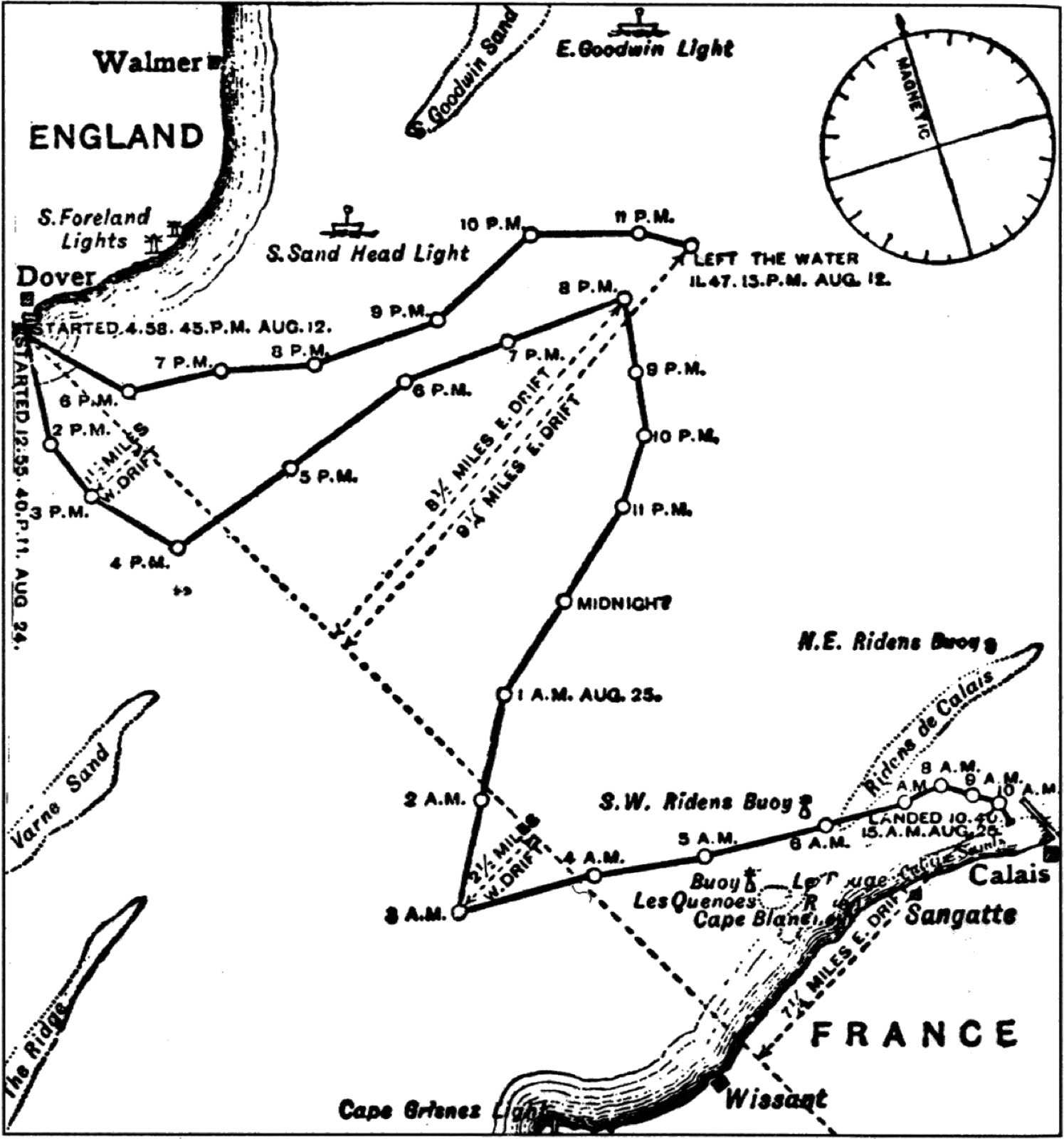
Matthew Webb, 24 August 1875 Matthew Webb, 27, tried for the first time on 12 August 1875 and had to stop due to wind and rough seas . On 24 August, shortly before 1:00 p.m., he dove from the Admiralty Pier in Dover . He swam breaststroke. Around 3:00 p.m. they passed him a beer, around evening some beef broth; after sunset, he was stung by a jellyfish . He touched the beach near Calais at 10:41 a.m. on 25 August, after 21 hours and 45 minutes (Royal Museums Greenwich ). It was the first unassisted swim across the English Channel .
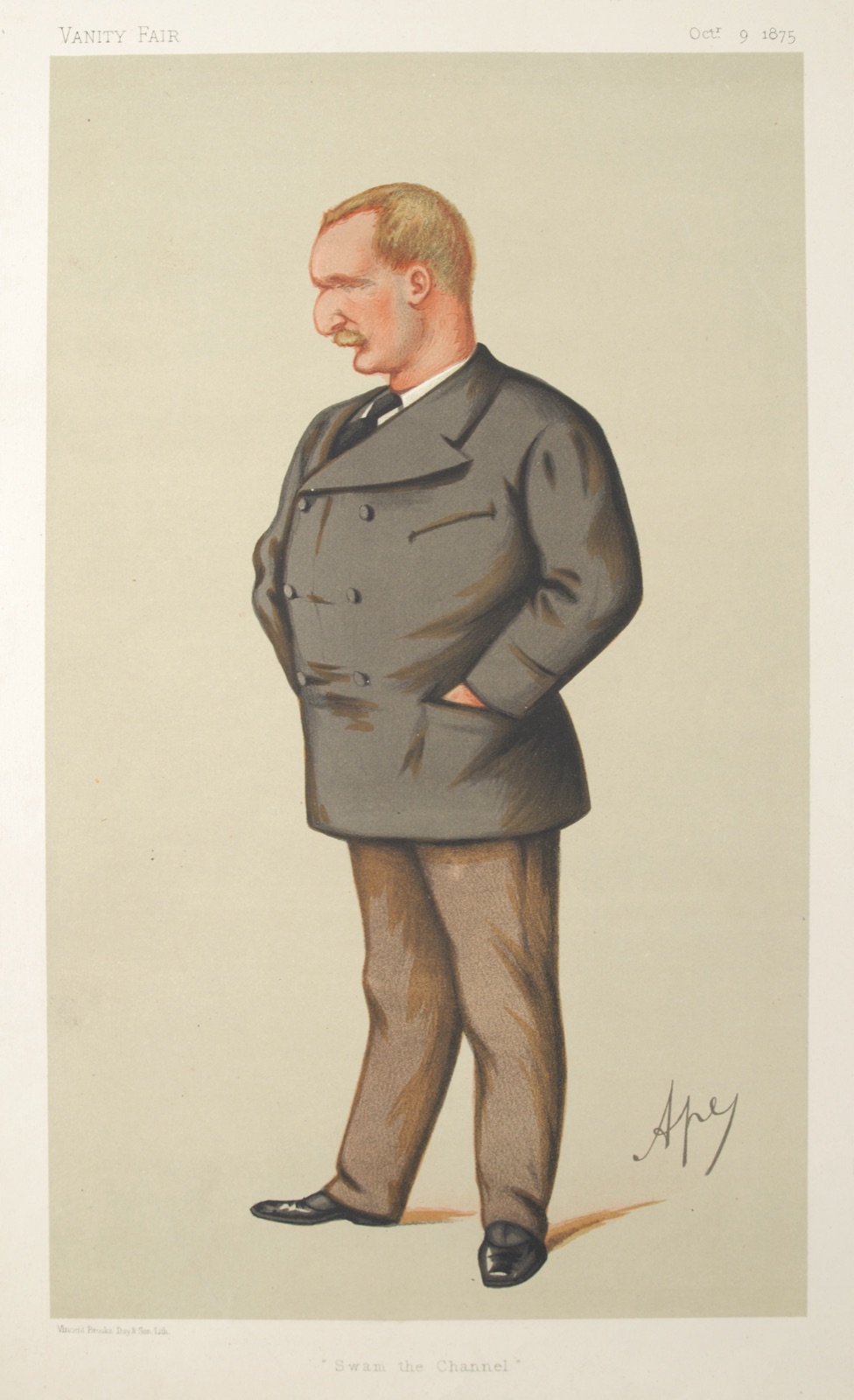
The routes of Matthew Webb's two attempts, 12 and 24-25 August 1875, hour by hour: the second reaches Calais. 1875 · Public domain The route, reconstructed hour by hour on the map, is the S-shape that the tide still dictates today. Six weeks later, Vanity Fair put him on the cover with three words: «Swam the Channel» .
Matthew Webb in Vanity Fair, 9 October 1875, six weeks after the crossing: «Swam the Channel». Carlo Pellegrini · 1875 · Public domain Thirty-six years for the second After Webb, many tried and no one succeeded. The Dover Museum counts the attempts of Montague Holbein, of Jabez Wolffe, who made at least twenty-two and swam to the sound of bagpipes to keep his stroke rhythm, and in 1905 of Annette Kellerman, the first woman to attempt it . The second success arrived only in September 1911: Thomas William Burgess, having set off from the South Foreland lighthouse, arrived in France after 22 hours and 35 minutes, wearing motorcycle goggles^4 .
In 1923, Enrico Tiraboschi, from Bergamo, who would emigrate to Argentina after the crossing, was the first to swim from France to England: from Cap Gris-Nez to the bay below Shakespeare Cliff in 16 hours and 33 minutes, five hours less than Webb^7 .
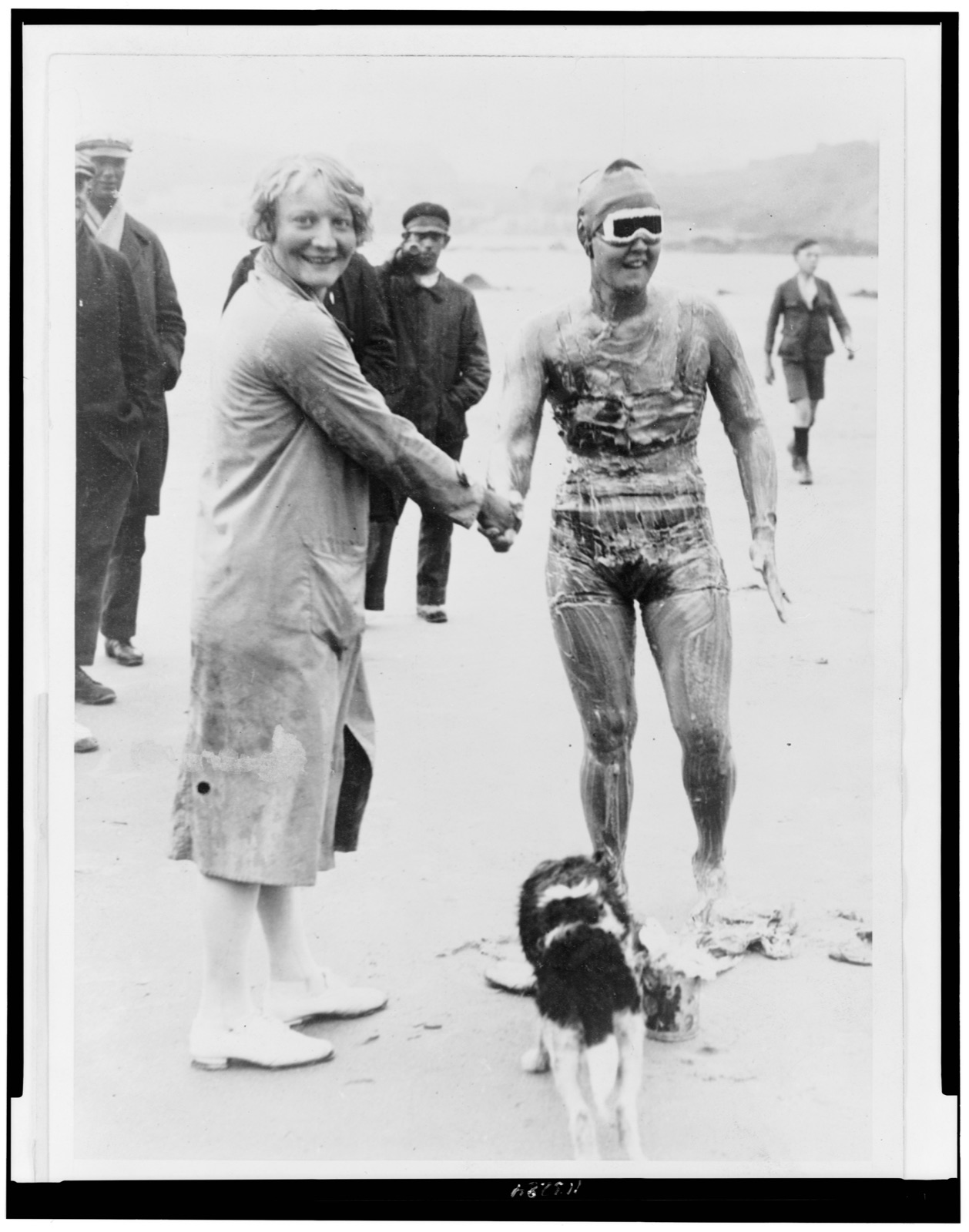
Gertrude Ederle, 6 August 1926 On 6 August 1926, the 20-year-old American Gertrude Ederle set off from Cap Gris-Nez covered in grease, wearing a two-piece swimsuit she had designed herself, and arrived in England in 14 hours and 39 minutes according to the register (other sources say between 14 hours and 31 minutes and 14 hours and 34 minutes)^10 . She was the first woman to cross the Channel, and she did it in nearly two hours less than the men's record . «They said women couldn't swim the Channel, but I proved they could,» she would later say . In New York, she was welcomed with a parade .
Gertrude Ederle, covered in grease, at the start from Cap Gris-Nez on 6 August 1926. New York World-Telegram and the Sun · Library of Congress · 1926 · Public domain The following year, on 7 October 1927, Mercedes Gleitze became the first British woman; a few months later she would be the first to swim the Strait of Gibraltar . That same year, the Channel Swimming Association was born, to prevent, the founders wrote, the feat from being ruined by artificial aids and unverified claims: its task is to authenticate crossings and verify their times .
The races, then multiple crossings Between 1950 and 1959, the Channel became a race, sponsored first by the Daily Mail and then by Butlin, starting from Cap Gris-Nez: in 1950 the Egyptian Hassan Abdel Rehim won, and the British swimmer Eileen Fenton was the first woman to finish . In 1961, the Argentine Antonio Abertondo made the first non-stop round-trip crossing, in 43 hours and 10 minutes . In 1981, Jon Erikson completed the first triple, in 38 hours and 27 minutes . On 15 September 2019, Sarah Thomas set off for the first quadruple: 54 hours and 10 minutes .
There are those who have done the Channel dozens of times. Alison Streeter swam it 43 times between 1982 and 2004 ; Chloë McCardel 44 times between 2009 and 2021, the last one on 13 October 2021^17 .
The times The shortest time in the register belongs to the German Andreas Waschburger: 6 hours 45 minutes and 25 seconds, on 8 September 2023 . Among women, the record remains with the Czech Yvetta Hlaváčová: 7 hours 25 minutes and 15 seconds, on 5 August 2006 . The longest crossing was by Jackie Cobell: 28 hours and 44 minutes, in 2010 . The youngest, Thomas Gregory, was 11 years and 11 months old in 1988 , before the rules set the minimum age at sixteen ; the oldest, the South African Otto Thaning, was 73 in 2014 .
Notes «The first recorded attempt was in 1872: J. B. Johnson gave up after about an hour» Dover Museum, Channel Swimmers: The Pioneers , dovermuseum.co.uk . «Matthew Webb, 27, tried for the first time on 12 August 1875 and had to stop due to…» Channel Swimming & Piloting Federation, Matthew Webb , cspf.co.uk . «after sunset, he was stung by a jellyfish» Royal Museums Greenwich, Captain Matthew Webb (1848–1883): the first person to swim the Channel , rmg.co.uk . «It was the first unassisted swim across the English Channel» Dover Museum, Channel Swimmers: Early Attempts , dovermuseum.co.uk . «Six weeks later, Vanity Fair put him on the cover with three words: «Swam the Channel»» Vanity Fair , «Men of the Day» n. 112, caricature by Carlo Pellegrini, 9 October 1875, Wikimedia Commons .«^4» Channel Swimming & Piloting Federation, solo crossing register, Thomas William Burgess swim in 1911 , cspf.co.uk . «^10» Dover Museum, Channel Swimmers: Between Wars , dovermuseum.co.uk . «^7» Channel Swimming & Piloting Federation, solo crossing register, Enrico Tiraboschi swim in 1923 , cspf.co.uk . «On 6 August 1926, the 20-year-old American Gertrude Ederle set off from Cap Gris-Nez…» Channel Swimming & Piloting Federation, solo crossing register, Gertrude Ederle swim in 1926 , cspf.co.uk . «She was the first woman to cross the Channel, and she did it in nearly two hours less…» Encyclopaedia Britannica, Gertrude Ederle , britannica.com . «a few months later she would be the first to swim the Strait of Gibraltar» Wenceslao Segura González, Mercedes Gleitze: el primer cruce a nado del estrecho de Gibraltar , Al Qantir 21, 2018, alqantir.es . «That same year, the Channel Swimming Association was born, to prevent, the founders…» Channel Swimming Association, About the CSA , channelswimmingassociation.com . «Between 1950 and 1959, the Channel became a race, sponsored first by the Daily Mail and…» Dover Museum, Channel Swimmers: 1950s Heyday , dovermuseum.co.uk . «In 1961, the Argentine Antonio Abertondo made the first non-stop round-trip crossing,…» Channel Swimming & Piloting Federation, solo crossing register, Antonio Abertondo swim in 1961 , cspf.co.uk . «In 1981, Jon Erikson completed the first triple, in 38 hours and 27 minutes» Channel Swimming & Piloting Federation, solo crossing register, Jon Erikson swim on 11 August 1981 , cspf.co.uk . «On 15 September 2019, Sarah Thomas set off for the first quadruple: 54 hours and 10…» Channel Swimming & Piloting Federation, solo crossing register, Sarah Thomas swim on 15 September 2019 , cspf.co.uk . «Alison Streeter swam it 43 times between 1982 and 2004» Channel Swimming & Piloting Federation, solo crossing register, Solo Swimmers , cspf.co.uk . «^17» Channel Swimming & Piloting Federation, solo crossing register, Chloë McCardel swim on 13 October 2021 , cspf.co.uk . «The shortest time in the register belongs to the German Andreas Waschburger: 6 hours 45…» Channel Swimming & Piloting Federation, solo crossing register, Andreas Waschburger swim on 08 September 2023 , cspf.co.uk . «Among women, the record remains with the Czech Yvetta Hlaváčová: 7 hours 25 minutes and…» Channel Swimming & Piloting Federation, solo crossing register, Yvetta Hlaváčová swim on 05 August 2006 , cspf.co.uk . «The longest crossing was by Jackie Cobell: 28 hours and 44 minutes, in 2010» Channel Swimming & Piloting Federation, solo crossing register, Jackie Cobell swim on 24 July 2010 , cspf.co.uk . «The youngest, Thomas Gregory, was 11 years and 11 months old in 1988» Channel Swimming & Piloting Federation, solo crossing register, Thomas Gregory swim on 06 September 1988 , cspf.co.uk . «, before the rules set the minimum age at sixteen» Dover Museum, Channel Swimmers: Records & Firsts , dovermuseum.co.uk . «the oldest, the South African Otto Thaning, was 73 in 2014» Channel Swimming & Piloting Federation, solo crossing register, Otto Thaning swim on 06 September 2014 , cspf.co.uk .