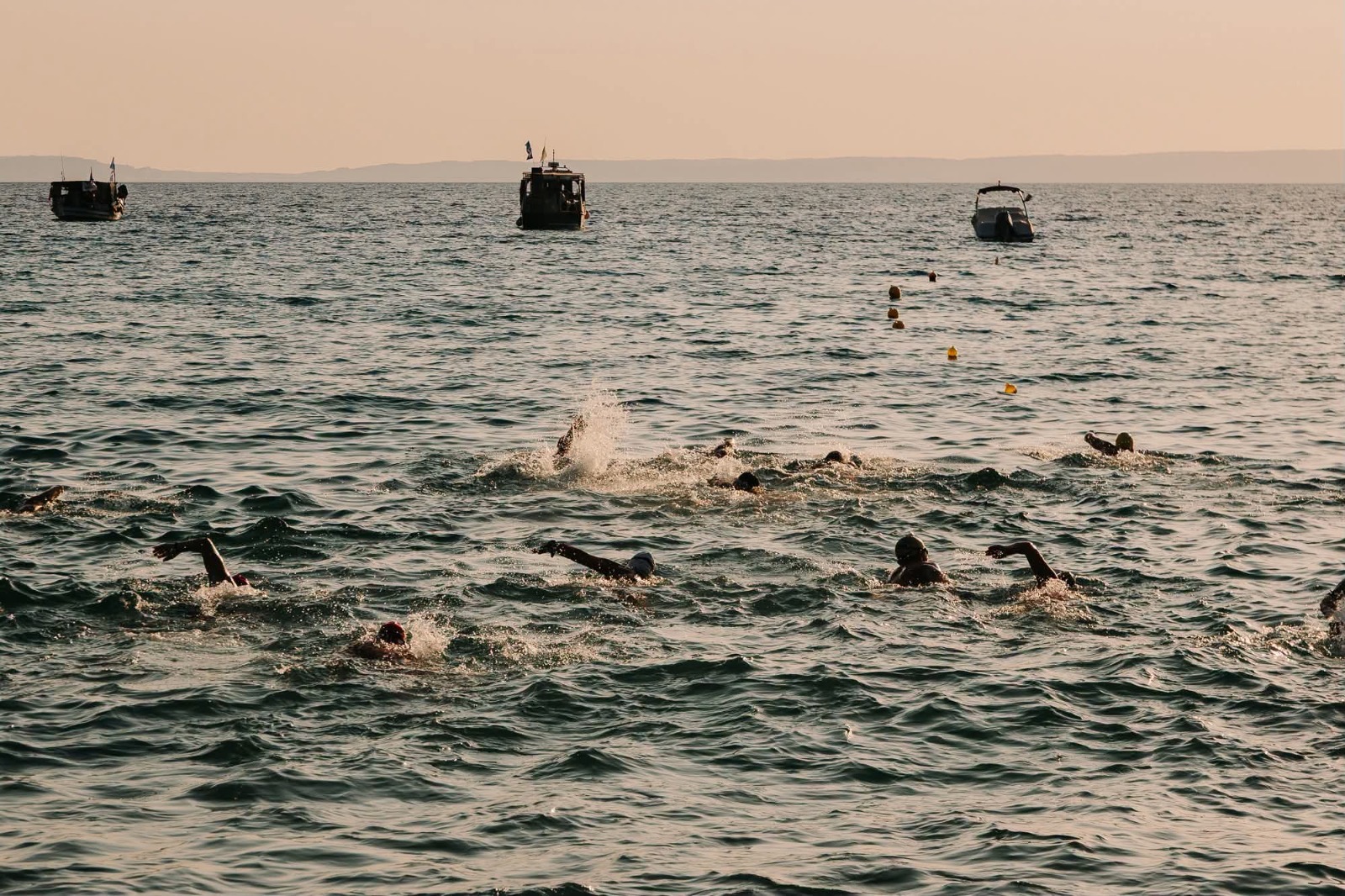
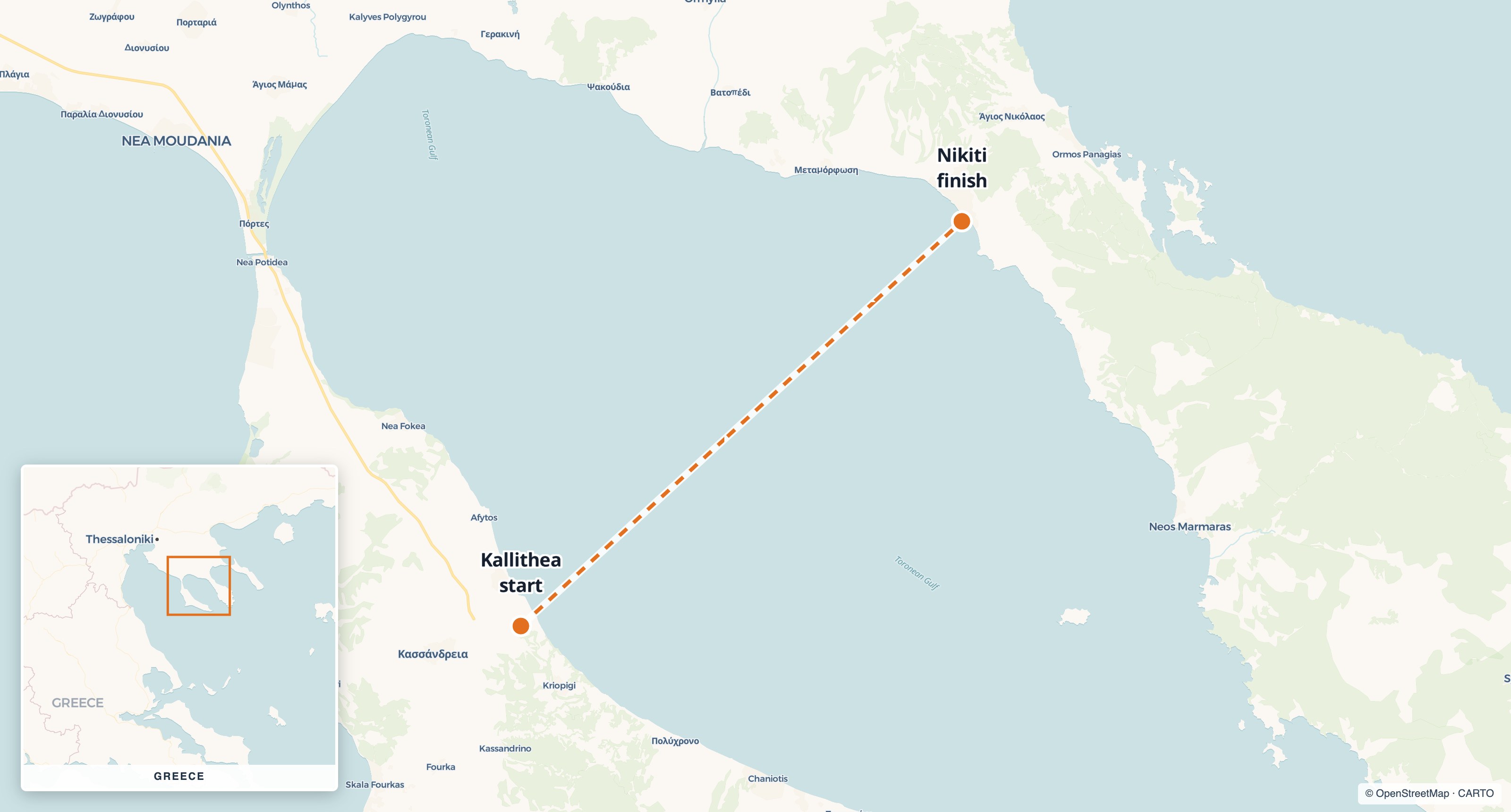
In Halkidiki, there is still a race from another era, one that retains an archaic and genuine flavor and has been celebrated since 1971 out of true passion rather than hype, marketing, or social media exhibitionism: the Toroneos Gulf crossing, 26 kilometers of open water from Kallithea, on the Kassandra peninsula, to Nikiti, on the Sithonia peninsula. It is one of the oldest crossings in Europe, initiated by a group of Nikiti residents in love with their sea, and on July 25, 2026, it reached its 56th edition (listed among the Top 100 crossings in the world).
Proof of how far it is from the hype is that if you don't swim, you have certainly never heard of it, and if you do swim, you probably haven't either. And that is precisely the point: in an era of races announced 12 months in advance with social media countdowns, the Toroneos continues to do what it has done for half a century: a race on the third weekend of July, about twenty swimmers in the water, and an entire town waiting for them on the beach.
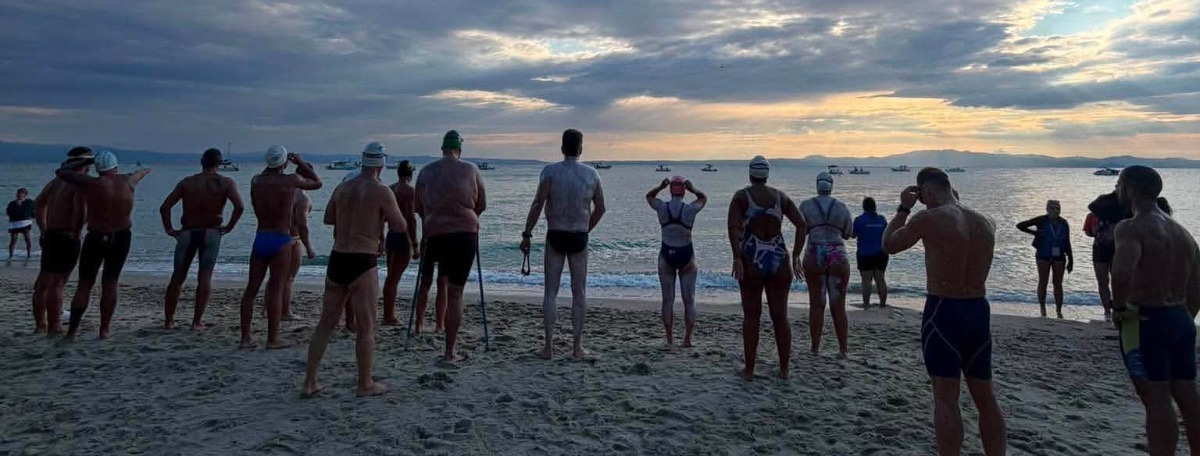
Twenty at the start, seventeen at the finish
In 2025, there were twenty starters and seventeen finishers, with the sea at force 6 (the race was won by Konstantinos Zachariadis in 6h54', followed by the sixteen-year-old Cypriot Alexandros Nourou in 7h12'). These are numbers from a race of another era. Being among the starters is a rare opportunity. And it is exactly the kind of gem we try to map and cover on Omniathlon, not so that it becomes mass-market, but so that it is appreciated.
How to discover a race like this
In the 2026 edition, among the 19 starters was Daniel Douglas Di Pierro, a long-distance swimmer who loves this type of race and has built formidable experience over the years in races over 20km (12 mi). We decided to interview him to find out more about this race, which is not easy to sign up for:
"In marathon swimming, you often discover races through word of mouth (we Italians are, after all, a tight-knit circle that often exchanges information about it). I thank my friend Diego Innocenti, who told me about it and explained that I should monitor the Facebook group linked to the local folk event (it was important to open the group every now and then and scroll through the myriad of unrelated posts to find the info related to the race)."
Being few, however, does not mean the race is improvised. The level in the water is high and the welcome for the athletes is structured:
"The organization was formidable; it even provides the hotel in the race fee, and I really appreciated how much emotional value they give to this event. I have never seen so much pathos in a marathon swim, complete with the presentation of the athletes on stage. I already knew the very strong Laura Volpi, and regarding their CVs, all 19 participants had an important swimming background (between former long-distance competitors or swimmers who have clocked up kilometers in crossings well over 30 km (19 mi))."
Inside the gulf
The gulf being crossed is the one between the first two "fingers" of Halkidiki. The first few hours of this edition offered no discounts:
"In the first half, the sea was choppy with one-meter waves, then it calmed down slightly; but it was never flat, it was a tough race. The first one finished in 6 and a half hours, I did it in 8 hours and 18 minutes (more or less in the middle of the pack)."
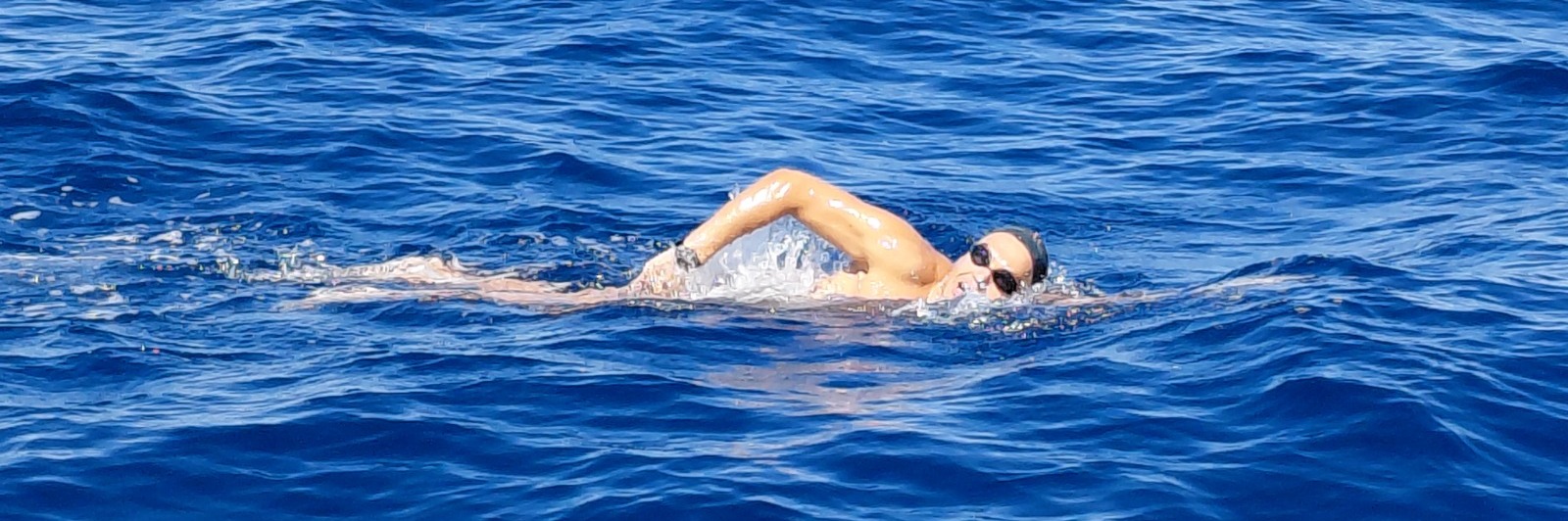
An impact with the water that forced you to immediately reckon with your physical and mental energy:
"As soon as I started swimming and noticed that we had almost a meter of waves, I thought, 'Okay, this is going to be very hard, but I'll make it!' and ironically, 'in my next life, I'll play bocce.'"
The race logistics also require a spirit of adaptation. No fleets of sleek kayaks:
"Escort via fishing boat; with kayaks, refueling is faster, but with a bit of organization and experience, you can easily minimize the feeds even if they are provided by boat (for example: an elastic hook tied to the water bottles)."
Then you enter the heart of the crossing. Seven, eight hours of blue where the real opponent is not the sea, but the perspective:
"The hardest moment? In the final quarter of the race, when the coast of Nikiti always seemed close but I couldn't perceive any more details on the shore, psychologically it felt like swimming in place!"
And in those hours of apparent stalemate, distractions disappear:
"You only hear the sound of the waves and my little voice in my head repeating: shut up and swim, shut up and swim."
Until the perspective finally changes:
"The image I'm taking home? Without a doubt, the coast of Sithonia; the moment I started to glimpse the beach umbrellas, it meant I was almost there! And when I saw the guys from the organization waiting for me in the water to celebrate my arrival, I got very emotional there—proof that I was now just a stone's throw from the finish line."
The finish is the town
Nikiti, at the finish, is a real seaside town, with a small harbor and old stone houses on the hill. It is the kind of place where the race is not an event dropped from above for tourism, but a town affair, handed down from edition to edition. You can tell by what happens the moment you put your feet on the sand:
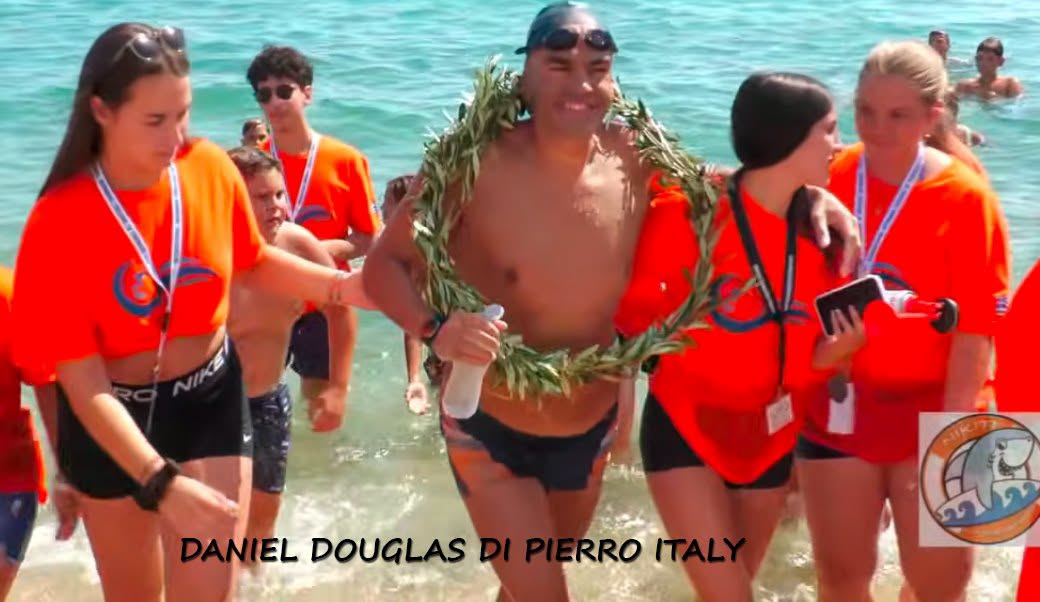
"Upon arrival, the organization's volunteers welcome you by hugging you, putting a giant laurel wreath around your neck (which counts for much more than a race pack, a celebration of the love and genuineness of the event), and in the background, epic Greek music (it felt like being in a Homeric poem, my personal odyssey brought to completion), and immediately after, a mini-interview on stage—yes, there was even a stage with an audience at the finish."
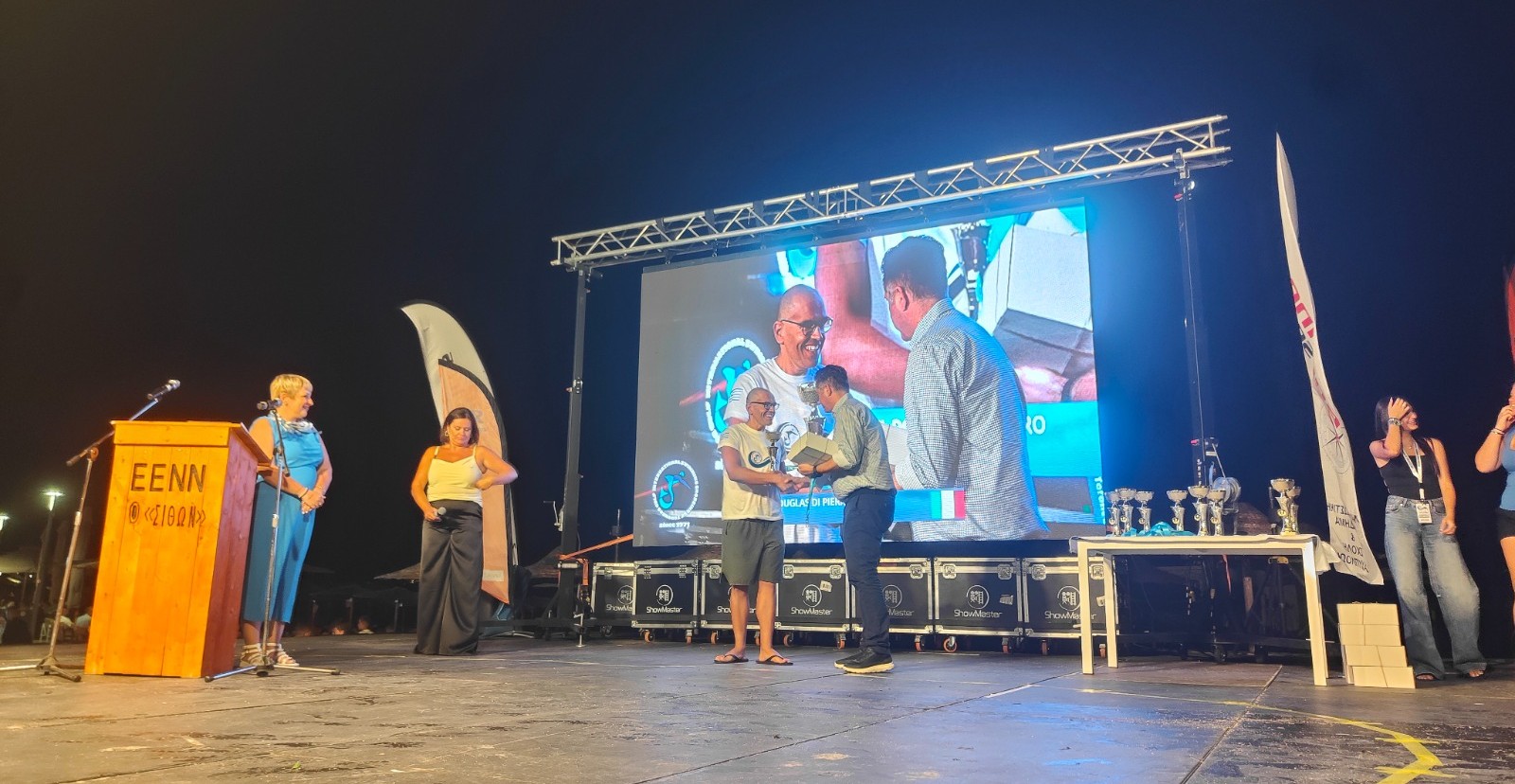
And here lies the difference from everything else on the calendar. No inflatable arch, no social media live stream: a pact between those who swim and a gulf, with a roll of honor (kept since 1971) and the entire community acting as the backdrop. You had proof of it when you went to dinner:
"In one of the places where I ate, the pizza maker recognized me seeing the event t-shirt and said, 'Beautiful event, I am one of the finishers from previous years.' It is a 'town' event in every respect, known by ALL the locals."
What remains
In the end, despite the fatigue, an experience so stripped of modern hype leaves something very precise:
"Knowing that you are participating in an event where the local population cares with all their heart, and the tenderness in seeing the children happy to hug and take photos with the athletes—that was beautiful."
Would you do it again?
"I tend to always aim for new places (as I also do with simple vacations), I don't think I'll do it again, but I feel like recommending it to anyone, both for the organization and for the beauty of the place and the emotions felt during and at the end."