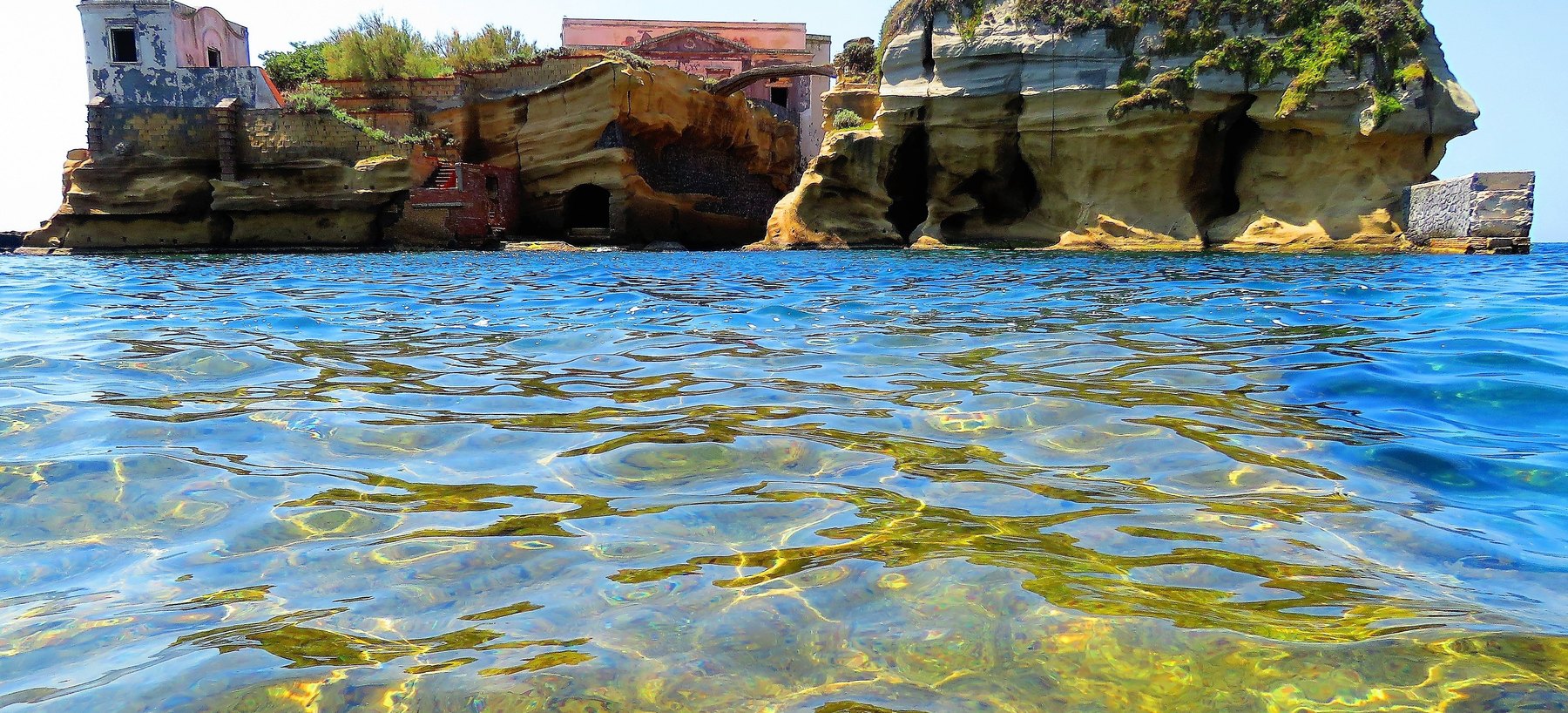
About twenty years ago, while rummaging through a second-hand book stall, a book caught my eye. It was a small volume of a few pages, printed by Editoriale Olimpia and titled Luigi Miraglia pioniere della caccia subacquea. I had been drawn by the sepia-toned cover photo: a man submerged waist-deep in the water, holding a spear, with a pair of goggles on his face that looked like an archaeological find from a Pacific tribe.
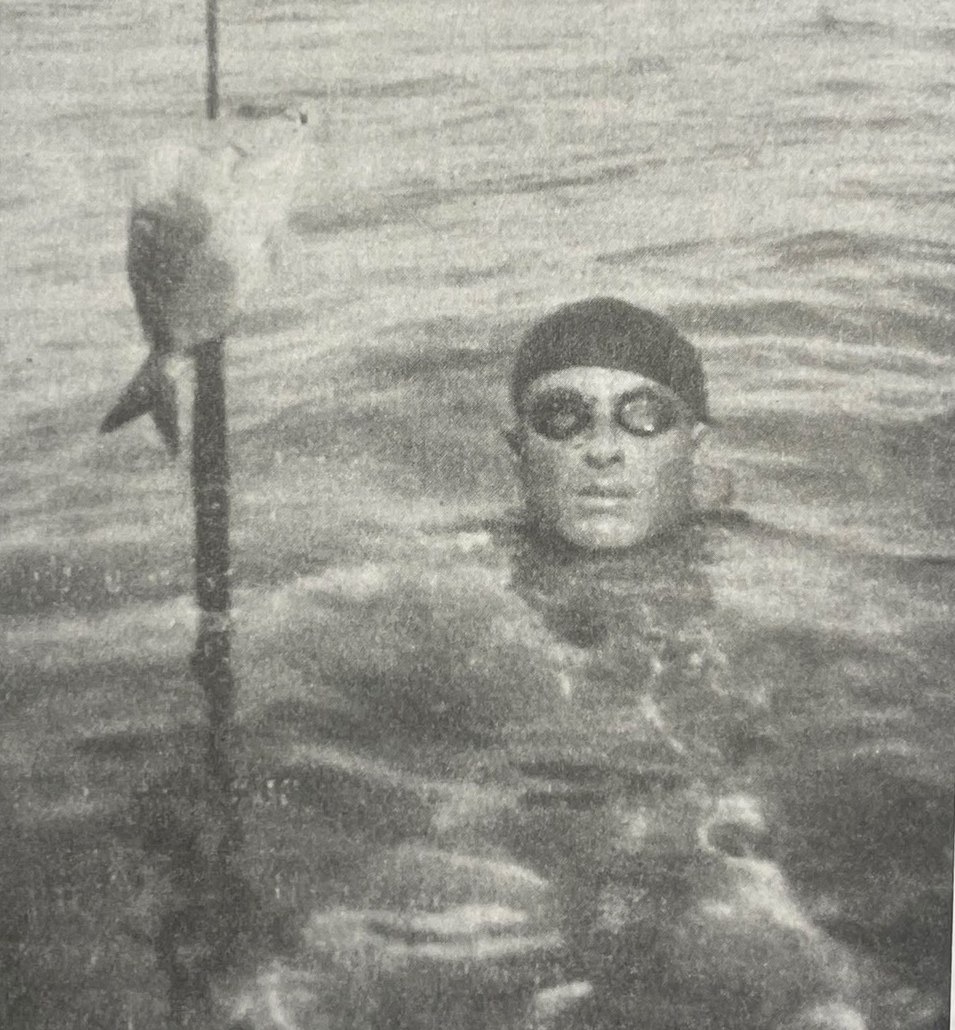
Leafing through it, I found myself sucked into a story as little-known as it is intriguing. That booklet collected the memoirs of the father of spearfishing and sea exploration — in the sense of being physically immersed in it — in the West. It is not, therefore, a simple "swimming story" but a story of the sea, of exploration, and of adventure. Because even we, who swim and clock up kilometers in open water today, are constantly living adventures, and observing what is beneath us is an integral part of the open water swimming experience. Knowing the history of the person who first broke the surface by entering the water to see what was underneath is a moral duty.
The glass illusion: the Anton Dohrn Station
We are in Naples, at the beginning of the 1930s. Miraglia is a character who seems to have stepped out of the pen of Salgari: a reserved naturalist, with a degree in botany and zoology, who works as an assistant at the prestigious Anton Dohrn Zoological Station, where he is in charge of the aquariums.
At that time, humanity knew fish in only two ways: dead on market stalls, or alive but trapped behind the thick glass of aquariums. Naples was a pioneer in this; the tanks at the Dohrn station were an excellence more unique than rare. Miraglia, with the surgical coldness of a scientist, understands that this view of fish behavior was influenced by their state of captivity.
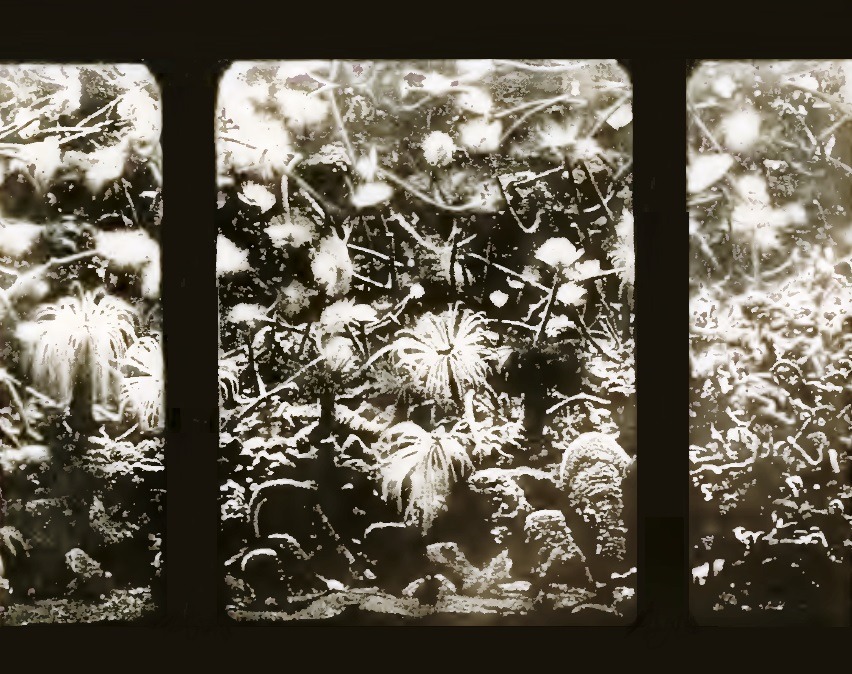
In his treatise, he writes words that for us at Omniathlon are a manifesto against the artificiality of closed waters: "While the morphology and systematics of fish are well known, the biology of these animals is little understood."
Miraglia lucidly analyzes the reasons why the aquarium prevents observation and understanding of fish biology. He describes the temperature fluctuations, with large ten-kilo groupers that in winter fill with necrotic sores and die from the cold of the water pumped into the tanks. He speaks of cod caught at a thousand meters that arrive with their swim bladders exploded due to decompression. He notes how the lack of the struggle for existence and the abundant food provided by humans dull the animals' instincts. Miraglia observes an old giant octopus that, at the mere sound of footsteps on the walkway, would rise to the surface, opening its mouth in anticipation of bits of anchovy. He does not say it openly, but it is likely he thought that studying an animal like that was fairly useless.
The secret of the three masters from Okinawa
The title of this paragraph is not mine: I stole it from a clipping from Il Mattino dated January 22, 1978, forty-six years after the events, which I found reproduced in the centenary book of the Circolo Canottieri Irno of Salerno — the club where the divers Miraglia had infected ended up, and the only place online where this story is told in full.
It is 1932, therefore, and we are on the Gaiola shoal — the Cajola, in the spelling of the time — in front of Posillipo, when Miraglia runs into three fishermen who came from Okinawa: Tukumori, his brother Soghi, and their uncle Tazuo Agarje.
Intrigued by these three Japanese fishermen in Naples in '32, I started looking. The first to arrive had been Tukumori, in the wake of a Dutchman from Java, for the Barcelona International Exposition, the fair that kept the Montjuïc pavilions open from May '29 to January '30 and in which private Japanese exhibitors also participated. Once the fair was over, Tukumori had smelled a business opportunity. It seems he had discovered that Naples had a very rich fish market and rock fish fetched higher prices than in any other city in Italy, so he called his brother and uncle to join him. He was not just any sportsman but a professional fisherman and had understood perfectly well that there was work to be done there.
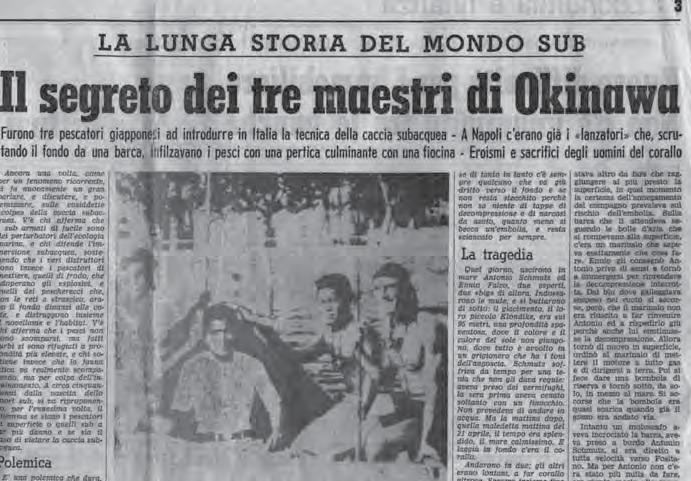
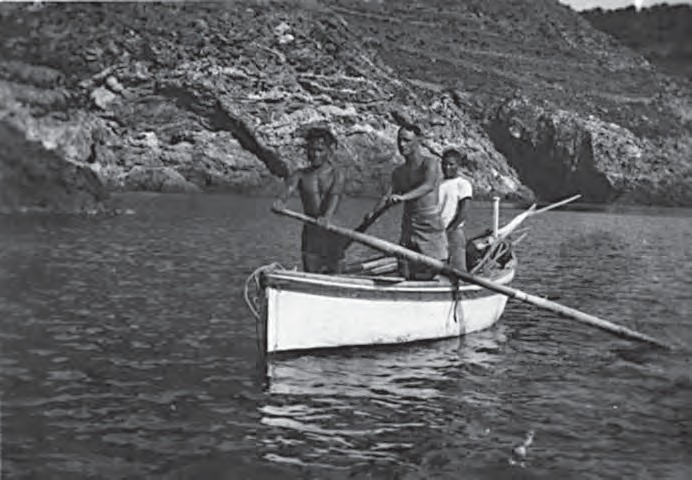
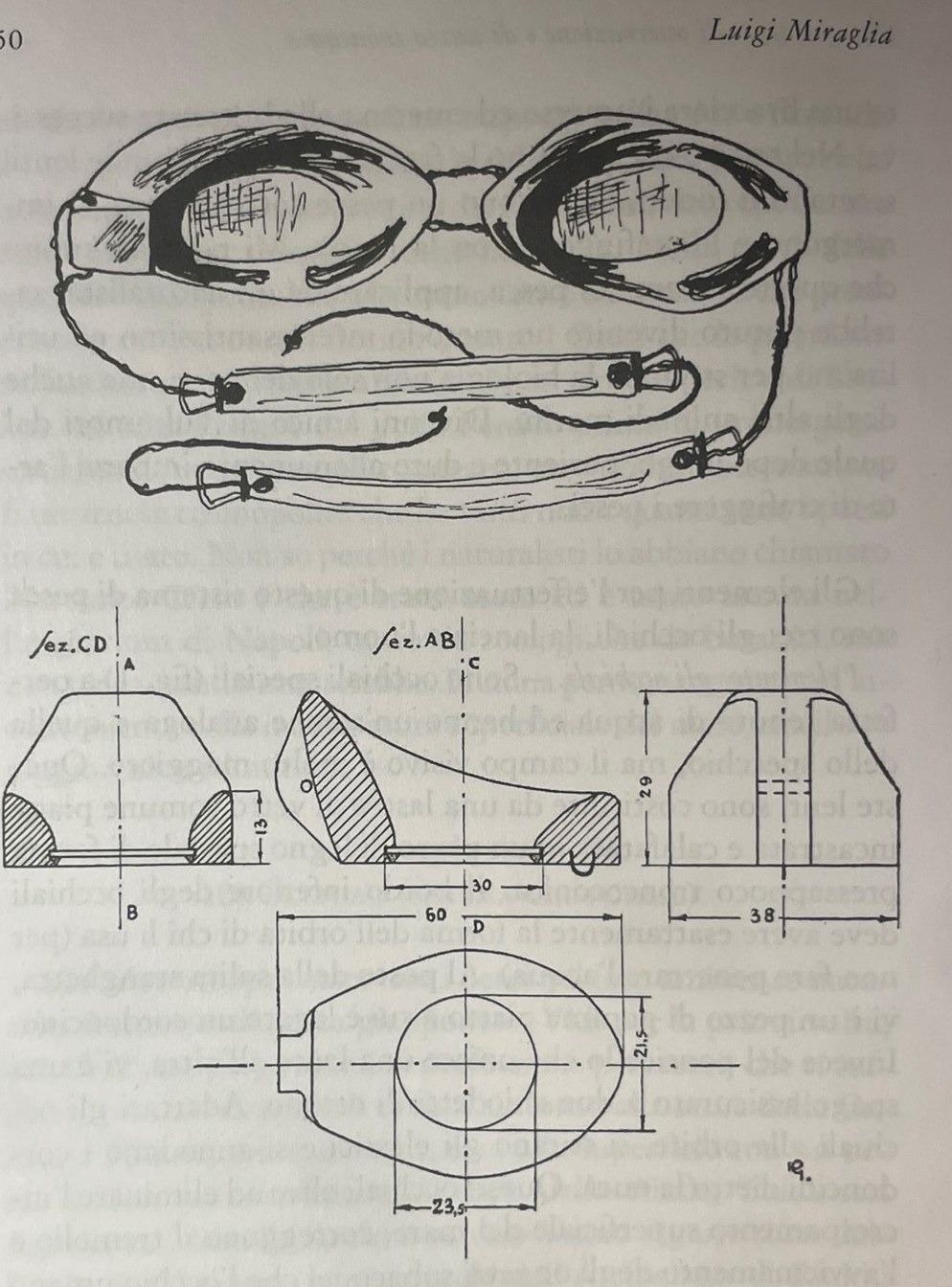
The three Japanese entered the water naked except for a cloth to hide their modesty, without tanks and barefoot because fins were yet to come, armed with a bamboo pole with an iron tip that they called sakana-ciuki, the fish-spearer. To see, they used wooden goggles with two small glass lenses set in, held tight behind the nape of the neck by a strap. At a depth of ten meters, unable to equalize pressure as we do today with modern masks, the wood was painfully pushed against their eye sockets.
Miraglia does not think twice. He builds himself wooden goggles according to their instructions, drops his academic safeguards, and dives with them, and from that encounter come three fishing campaigns between the summer of '32, that of '33, and that of '34. They spend their days aboard a rowing and sailing Sorrentine gozzo, from the gulfs of Naples and Salerno hunting groupers and sea bream along the entire central-southern coast, up to the Pontine Islands and down to Sicily. They sleep at anchor or on beaches and live off the fish they sell.
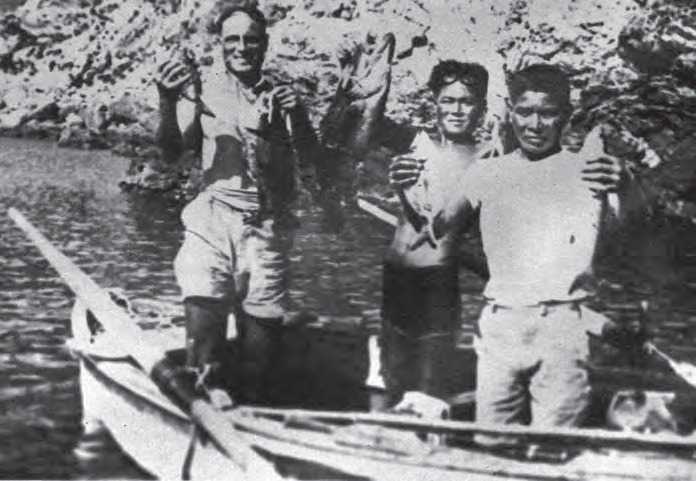
We know how much they caught from him, and it is also the reason why the local fishermen did not look kindly upon them: in his 1935 publication, Miraglia notes that between August 28 and September 2, 1933, in Calabria between Capo Vaticano and Nicotera, in six days at sea they caught eighty groupers for a total of 329 kg (725 lb).
And then there is what he wrote, once he returned to land. In the spring of 1935, his report Nuovo sistema di osservazione e di caccia subacquea was published in the Bollettino di Pesca, Piscicoltura e Idrobiologia, the journal of the Ministry of Agriculture's hydrobiology laboratory. Sixty pages in two parts, the first on how to observe fish and how to hunt them, the second on the habitats of the Tyrrhenian Sea and the habits of the animals. For the Historical Diving Society Italia, that is, absolutely, the first spearfishing manual to appear in the Western world, three years before Guy Gilpatric's The Compleat Goggler and five before Raymond Pulvènis's La chasse aux poissons. It is also the first book on the biology and ethology of Mediterranean fish written by someone who had seen the fish with their own eyes and in their natural environment. That very report, reprinted in full, is the body of the booklet I bought at the stall twenty years ago.
After these three years of fishing, the three Japanese masters returned home on the eve of the Second World War. The centenary book of the Circolo Canottieri Irno, which is also the only place where I found this story in full, gets by with just one line and an implicit conditional: "the chronicles of the time say there are two of them. One of them remained forever at the bottom of the sea of Ponza." Who the third was, and what really happened, no one says.
The privilege of the first look
Today, every one of us who swims in open water in the Mediterranean crosses at least a million sea bream, saddled bream, or brown meagres. We take for granted the privilege of seeing them dart away fast and shimmering beneath our bodies. But before 1932, in the West, no one had ever done it, or rather, no one remembered it anymore: the Sicilian coral divers of the sixteenth century were the first to use a piece of glass fixed in front of their eyes, but that tradition had been lost without leaving heirs. Centuries later, when Matthew Webb swam the Channel, he did it with the breaststroke and without goggles. Bill Burges and Gertrude Ederle in the early 1900s were the first swimmers to use goggles, but they were motorcycle goggles readapted and sealed as best as possible with paraffin, and they were not used to look underwater, but only to keep water away from the eyes.
When Miraglia puts on his wooden goggles and swims "like a soldier," only to then sprint with the breaststroke underwater, fishing with his companions from Okinawa, he performs a historic act: it is the first time in centuries that a Western human eye has observed those very common fish in their natural element, alive and free. In Japan, however, it had already been done for some decades. Miraglia sees the fish hunting, hiding, breathing, trusting him, because they were accustomed for millennia to fear only nets from above and not a human predator capable of facing them in their own liquid. The water is no longer an opaque wall, but a three-dimensional world that exploded suddenly in front of his corneas.
The dynamiters and the stolen sea
Unfortunately, Miraglia's exploration also records the beginning of the end. In the book, he dedicates sad notes to the dynamiters. While he was learning to hold his breath with a respect for the ecosystem and an environmental conscience that was absolutely pioneering for the time, the "bombers" were infesting the Italian coasts, gutting the seabed just to collect a few kilos of fish floating on the surface.
There were the "professionals" on flat-bottomed boats, who sprayed oil on the water to cancel the ripple of the waves and placed the bombs, leaving a desert behind them. Miraglia understands that that destructive arrogance, combined with what he already then sensed was the prelude to the water we have thrown away, would have turned the sea into a graveyard.
An incredible life could only continue like this
On the back cover, in the flap about the author's biography, it is barely mentioned: "Around 1960 he seems to have moved to Paraguay."
Such a character could not have disappeared into thin air like that, without leaving traces. I started looking for him; I crossed archives, consulted registers, and even sent a couple of emails to South America.
I discovered that Luigi Miraglia had not retired to enjoy his pension. I found him where I did not expect, in the record of a photographic collection kept at the Museum of Civilizations in Rome, the former Pigorini: fifty-four negatives, in black and white and color, all about his meeting with a group of Guayakí Indians at a road construction site in the forest. The record says that in 1946, having retired, he had moved to South America, and that in 1952 he was directing the "Pisciculture and Hydrobiology" section of the Paraguayan Ministry of Agriculture in Asunción. Here he became passionate about the life of the forest Indians, learned their language and traditions, and ended up becoming the recognized chief of the Maká.
Except that, as soon as you line up the dates, not one of them adds up. The Paraguayan biographical dictionary has him settled in Paraguay as early as 1925, the Centenary Book of the Circolo Canottieri Irno says he left Salerno in '48 and Italy in '55, and in between there is something that none of the three chronologies can explain: in 1941, while he was teaching science at the Tasso high school and Italy was at war, Luigi Miraglia was publishing in the Vatican, in the Annali Lateranensi, one hundred and twenty-six pages of Paraguayan ethnography — Gli Avá, i Guayakí ed i Tobas (indigeni del Paraguay e regioni limitrofe), from page 253 to 378 of the fifth volume. These are not the notes of a pensioner looking around; it is the work of someone who already knew that continent very well, and this opens a question I cannot yet answer: when had he gone there for the first time? I hypothesize that in those years he was traveling in some way between Italy and Paraguay.
From then on, he never stopped. Gli Aché o Guayakí was published in 1961 in the Archivio per l'Antropologia e la Etnologia; in 1968 he recorded the freshwater jellyfish Craspedacusta sowerbyi in Paraguay for the journal of the Sociedad Científica del Paraguay, proving that the boy from the Dohrn tanks had never completely left. In 1973 he co-authored with the Jesuit Bartomeu Melià and with Mark and Christine Münzel La agonía de los Aché-Guayakí: historia y cantos, for the Centro de Estudios Antropológicos of the Catholic University of Asunción.
That book is much more than an academic work, and that is how the Paraguayan State read it when, in August 2008, its truth commission delivered the Informe Final. On page 165 of the third volume, the Comisión de Verdad y Justicia reports verbatim the testimony of Miraglia — getting his name wrong, "Luigui," just as it would get it wrong again eight pages later, "Luicci":
> "Para los peones paraguayos del este, matar a un Guayakí no sólo no constituye un delito, sino es una acción digna de elogio, como cazar un jaguar. El paraguayo Maximiliano Vera me contó que cuando hacía de guía en los alrededores de Ajos, recibía un premio de 300 a 500 pesos por cada Guayakí que mataba."
For the Paraguayan laborers of the east, killing a Guayakí is not only not a crime: it is an action worthy of praise, like hunting a jaguar. Someone told me that when he was a guide in the surroundings of Ajos, he received a prize of 300-500 pesos for every Guayakí he killed. And in the following pages, the same report cites his work on the two Aché captures of April 1972, where he recounts how they had been hunted down and led to Arroyo Guasu by a team of "decoys," domesticated Guayakí. Facts that in 1974 would end up before the United Nations Commission on Human Rights and the Inter-American Commission.
Outside of Paraguay, the record of the Roman collection attributes even harsher denunciations to him. In Peru, he denounced the bombing of Jaminahua villages by private planes of oil companies. In Colombia, Desana villages burned to make room for a rubber factory. According to Miraglia's testimony, hitmen disguised as doctors had inoculated active smallpox and cholera viruses, and white fazenderos on the Guahibo plateau had practiced hunting the Indian. In Colombia, he denounced the vilest thing of all: bags of sugar mixed with arsenic parachuted onto villages from above, to poison entire communities without getting their hands dirty.
Of these last denunciations, I have not been able to find a trace anywhere other than the archive record. I hypothesize that the underlying papers are inside those fifty-four films that I believe are not digitized or, perhaps, in some folder in Asunción. I do not deny that I would very much like to know what is written there.
I am incredibly fascinated by the figure of this professor who, decades earlier, could not stand to see an octopus begging for food in a tank, then fished for 3 years with three Japanese, and finally dedicated his existence to defending life from the monstrosities of those who wanted to annihilate it, dying in Asunción on January 5, 1976.
This is the story of Luigi Miraglia, and I think it should be more studied and known. The next time you dive into the sea, remember him and the three Japanese masters who taught us to look beneath the sea.